# 堆:求解 TopK

# 堆
堆是一种数据结构,需要满足如下几个特性
- 堆是一颗完全二叉树(生成节点的顺序是从左往右,从上往下依次进行)
- 堆中某个节点值总是不大于或者不小于其父节点的值
将根结点最大的堆叫做最大堆或大根堆,根结点最小的堆叫做最小堆或小根堆

大根堆和小根堆如下图所示

大部分语言都会内置堆的实现,即优先级队列(Java中为PriorityQueue),所以当我们有用到堆的场景时,直接用PriorityQueue即可
// 小根堆
int[] array = {1, 7, 3, 5, 8};
PriorityQueue<Integer> queue = new PriorityQueue<>();
for (int i = 0; i < array.length; i++) {
    queue.add(array[i]);
}
// 1 3 5 7 8
while (!queue.isEmpty()) {
	// 返回队列的第一个元素并删除
    System.out.println(queue.poll());
}

// 大根堆
queue = new PriorityQueue<>((num1, num2) -> num2 - num1);
for (int i = 0; i < array.length; i++) {
    queue.add(array[i]);
}
// 8 7 5 3 1
while (!queue.isEmpty()) {
    System.out.println(queue.poll());
}
# 堆的应用场景
面试中常问的Top k问题,就可以先排序,然后求出Top k的元素
更高效的思路是用堆和快排。Top K问题问法很多,本质思路都一样,例如求前K个最大的元素,求前K个最小的元素,求前K个高频元素
# 数组中的第K个最大元素
题目地址:LeetCode 215
题目描述:
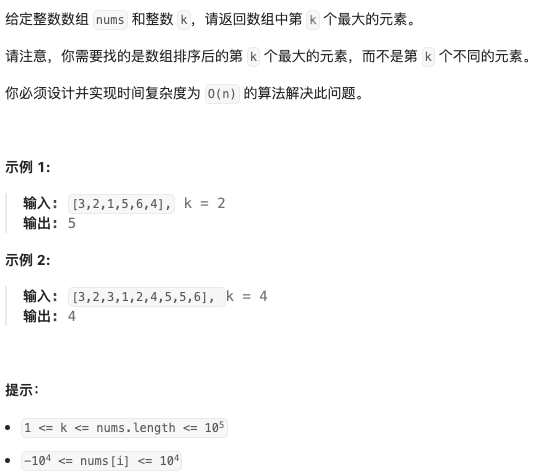
维护一个小顶堆,数量不足 k 个时,一直往堆中存放元素,超过 k 个时,删除堆中最大的元素
public class Solution {

    public int findKthLargest(int[] nums, int k) {
        PriorityQueue<Integer> heap = new PriorityQueue<>();
        for (int n : nums) {
            heap.add(n);
            if (heap.size() > k) {
                heap.poll();
            }
        }
        return heap.poll();
    }

}
用快速排序倒序排,判断 k 和 基准值的坐标,来决定对哪段分区进行排列,或者直接返回
public class Solution {

    public int quickSort(int[] a, int left, int right, int k) {
        if (left >= right) {
            return a[right];
        }
        int x = left, y = right, z = a[left];
        while (x < y) {
            while (x < y && a[y] <= z) {
                y--;
            }
            if (x < y) {
                a[x++] = a[y];
            }
            while (x < y && a[x] >= z) {
                x++;
            }
            if (x < y) {
                a[y--] = a[x];
            }
        }
        a[x] = z;
        if (k >= left && k <= x - 1) {
             return quickSort(a, left, x - 1, k);
        }
        if (k >= x + 1 && k <= right) {
            return quickSort(a, x + 1, right, k);
        }
        return a[x];
    }

    public int findKthLargest(int[] nums, int k) {
        return quickSort(nums, 0, nums.length - 1, k - 1);
    }

}
# 最小的k个数
题目地址:剑指 Offer 40. 最小的k个数
输入整数数组 arr ,找出其中最小的 k 个数。例如,输入4、5、1、6、2、7、3、8这8个数字,则最小的4个数字是1、2、3、4。
输入:arr = [3,2,1], k = 2
输出:[1,2] 或者 [2,1]
限制:
0 <= k <= arr.length <= 10000
0 <= arr[i] <= 10000
堆
维护一个大顶堆 当堆中的元素不够k时,一直往堆中放元素即可 当堆中的元素大于等于k时,将堆顶的元素和新添加的元素进行比较。如果新添的元素比堆顶的元素小,则应该把堆顶的元素删除,将新填的元素放入堆,这样就能保证堆中的元素一直是最小的k个
public int[] getLeastNumbers(int[] arr, int k) {
    if (arr.length == 0 || k == 0) {
        return new int[0];
    }
    PriorityQueue<Integer> queue = new PriorityQueue<>((num1, num2) -> num2 - num1);
    for (int num : arr) {
        if (queue.size() < k) {
            queue.add(num);
        } else if (num < queue.peek()) {
            queue.poll();
            queue.add(num);
        }
    }
    int[] result = new int[k];
    for (int i = 0; i < k; i++) {
        result[i] = queue.poll();
    }
    return result;
}
计数排序
因为题目中有这样一个条件0 <= arr[i] <= 10000,说明数组中的元素比较集中,我们就可以用计数排序来解决这个问题,因为arr[i]的最大值10000为,所以我每次直接开一个10001大的数组
public int[] getLeastNumbers(int[] arr, int k) {
    if (arr.length == 0 || k == 0) {
        return new int[0];
    }
    int[] countArray = new int[10001];
    for (int num : arr) {
        countArray[num]++;
    }
    int[] result = new int[k];
    int index = 0;
    for (int i = 0; i < countArray.length && index < k; i++) {
        while (countArray[i] > 0 && index < k) {
            countArray[i]--;
            result[index++] = i;
        }
    }
    return result;
}
# 前 K 个高频元素
题目描述:
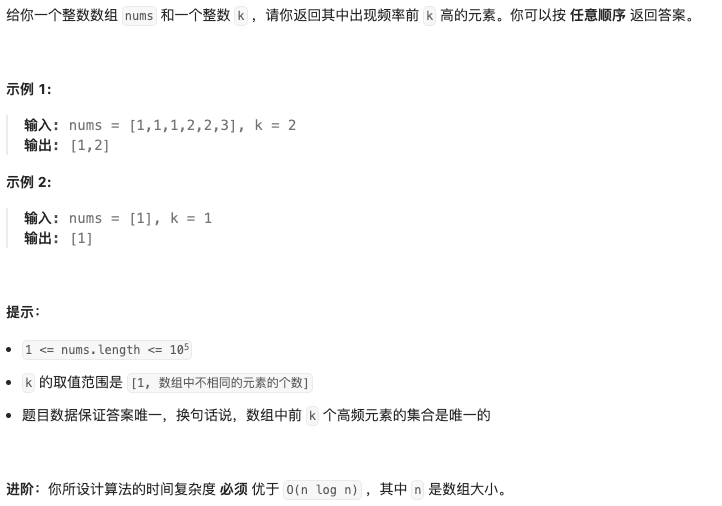 题目地址:LeetCode 347
class Solution {

    public int[] topKFrequent(int[] nums, int k) {
        PriorityQueue<int[]> queue = new PriorityQueue<>((a1, a2) -> a1[1] - a2[1]);
        Map<Integer, Integer> map = new HashMap<>();
        for (int num : nums) {
            map.put(num, map.getOrDefault(num, 0) + 1);
        }
        for (Map.Entry<Integer, Integer> entry : map.entrySet()) {
            int key = entry.getKey();
            int value = entry.getValue();
            if (queue.size() < k) {
                queue.add(new int[] {key, value});
            } else if (queue.peek()[1] < value){
                queue.poll();
                queue.add(new int[] {key, value});
            }
        }
        int[] result = new int[k];
        for (int i = 0; i < k; i++) {
            result[i] = queue.poll()[0];
        }
        return result;
    }
}