# 哈希:更高效的查找!

# 面试必问的HashMap
我们在开发的过程中经常会用到HashMap来保存键值对,实现的主要思路,就是通过hash函数确定对应的key应该放在数组的哪个位置。
当要放的位置发生冲突时,就需要解决冲突,一般情况下有两种如下方法
- 开放寻址法(当要放的位置上有值的时候,依次找数组的下一个位置,看是否有空位)
- 链表法(用链表存储发生冲突的元素)
当我们想要保证放入的key有序时,我们就可以用LinkedHashMap,LinkedHashMap=哈希表+双向链表
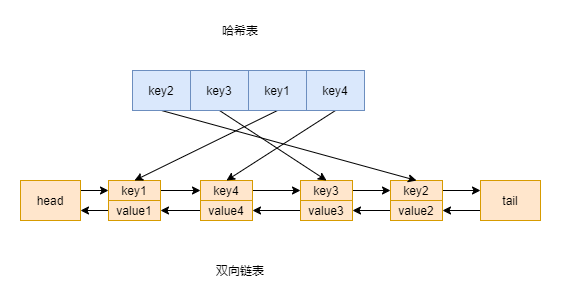 哈希算法在Java中的应用有集合类HashMap,HashSet等,本质上就是用来保存映射关系的
但保存映射关系的数据结构不只有哈希表,数组也可以。计数排序不就用数组的下标i以及其对应的值a[i]来表示值为i的数有a[i]个
# 输出频率最高且最先出现的字符
假设有一个字符串,字符串内部的所有字符都是在ascii编码的范围内,编码求出字符串中出现频率最高的字符,如果频率最高的字符有几个字符出现的频率一样,则输出最先出现的字符。
如输入串为 “hello world, every body!”,则输出频率最高且最先出现的字符
我们可以通过哈希表这种结构得到每个字符出现的频率,但是当最高的字符出现频率一样时,需要输出最先出现的字符,应该如何保存这种顺序呢?
我们用LinkedHashMap不就能同时保存字符出现的顺序和字符出现的频率了吗?
public char getMaxOccurChar(String str) {

    int maxCount = 1;
    Character result = new Character(str.charAt(0));

    Map<Character, Integer> map = new LinkedHashMap<>();
    for (int i = 0; i < str.length(); i++) {
        Character content = str.charAt(i);
        map.put(content, map.getOrDefault(content, 0) + 1);
    }

    for (Map.Entry<Character, Integer> entry: map.entrySet()) {
        if (entry.getValue() > maxCount) {
            maxCount = entry.getValue();
            result = entry.getKey();
        }
    }
    return result;
}
遍历两次,第一次遍历将字符的出现频率放入哈希表中。第二次遍历哈希表,找出出现频率最高的字符。
有没有可能一次遍历解决这个问题呢? 正着一边遍历一边比较大小试试看?
public char getMaxOccurChar(String str) {

    int maxCount = 1;
    Character result = new Character(str.charAt(0));

    Map<Character, Integer> map = new LinkedHashMap<>();

    for (int i = 0; i < str.length() ; i++) {
        Character content = str.charAt(i);
        Integer count = map.getOrDefault(content, 0);
        map.put(content, count + 1);
        if (count + 1 >= maxCount) {
            maxCount = count + 1;
            result = content;
        }
    }
    return result;
}
这种会有什么问题呢?如果输入的字符串是aaaccc,则最终的输出是c,不是a,不符合题意。 发现是程序中count + 1 >= maxCount中的>=造成的,我们把>=改成>不就行了。 如果把>=改为,针对如下输入baab,最终的输出是a,不是b,不符合题意
倒着遍历可以解决这个问题吗?
public char getMaxOccurChar(String str) {

    int maxCount = 1;
    Character result = new Character(str.charAt(0));

    Map<Character, Integer> map = new LinkedHashMap<>();

    for (int i = str.length() - 1; i >= 0 ; i--) {
        Character content = str.charAt(i);
        Integer count = map.getOrDefault(content, 0);
        map.put(content, count + 1);
        if (count + 1 >= maxCount) {
            maxCount = count;
            result = content;
        }
    }
    return result;
}
当然可以,通过倒序来保证最终求出的结果是最先出现的
# 最长连续序列
题目地址:LeetCode 128. 最长连续序列
给定一个未排序的整数数组 nums ,找出数字连续的最长序列(不要求序列元素在原数组中连续)的长度。
请你设计并实现时间复杂度为 O(n) 的算法解决此问题。
示例1
输入:nums = [100,4,200,1,3,2]
输出:4
解释:最长数字连续序列是 [1, 2, 3, 4]。它的长度为 4。
因为题目要求O(n)的时间复杂度,所以不能排序。我们可以遍历每个数num,假设它是某个序列的开头,那么需要满足num-1不在数组中,然后从num+1开始递增,查找对应的数是否在数组中。通过打擂台的方式求出最长连续序列。
public int longestConsecutive(int[] nums) {
    Set<Integer> set = new HashSet<>();
    for (int num : nums) {
        set.add(num);
    }
    int max = 0;
    for (int num : nums) {
        if (!set.contains(num - 1)) {
            int sum = 1;
            while (set.contains(++num)) {
                sum++;
            }
            max = Math.max(sum, max);
        }
    }
    return max;
}